Showing posts with label Grayson-Perry. Show all posts

Sunday, December 9, 2012

Grayson Perry

The thing I loved most about this interview, was really, how media friendly Grayson truly is. This aspect of his personality really comes out in his work. He's just “a guy in a dress” being funny and happily taking on the role of clown. His works are big normal classic pots with pretty colors and pictures, until you look closer at the images and then see the more disturbing darker subject matter. 

When someone in the audience asks him, “if someone can learn to be an artist” his response is “No. Someone can learn a craft but an artists job is to bring their life experience to the craft. Therapy can help with this.”

Grayson Perry is an Artist, and not just a ceramicist or potter, because he brings his own life experiences to his ceramic pots, (his main medium is the collage, drawings ,and paintings he puts on the pots). One of my favorite quotes from this interview was, “You wouldn't call Damien Hirst a Taxidermist.”

I also loved the quote of Freud's “vanity of small differences.” as Grayson puts it, "You don't hate anyone as much as your nearest neighbor."  Unfortunately, it feels like I've been having to deal with this vanity from people lately. It is a real phenomenon associated with ceramics. Other artists working in other mediums have a real hatred for ceramics and other crafts and it's much deeper than just snobbery.   

Monday, November 26, 2012

Joy Chadwick

Grayson Perry


I found it useful to hear again from Grayson, self defined artist-not-potter, the definition of craft as learned or taught technique, a certain set of processes.  Art is linked to individuals and their visions, and, rather than the lovely and the logical,  Grayson says, brings serious irrationality into the world. Although Grayson is in awe of quality craftsmanship and makes excellent pots, he is that artist I want to be, one who reveals his personal aesthetics and truth-seeking in creating original pieces. Grayson the artist is clear that he creates art merchandise for an art audience and exhibits in fine art gallery settings. As an artist not a potter he chooses the vessel surface to draw and paint context and content –questions about human rituals, global issues, etc. I admire Grayson’s simple and direct conversations about art, craft and function. I have a much better definition and understanding for my own work.

I like the certainty he displays about ownership of his place in contemporary art, to the extent that he is comfortable bringing female fashions (cross-dressing) designed by his students, into the mix. Although Grayson’s created feminine attires are deliberately befuddled for anyone’s tastes, reasons why are also layered, because Grayson has become “branded” and the viewer expects a pun or satire. He said that sometimes an idea comes out and maybe gets dismissed, later to be successful, such as using a childhood toy to project feelings. Thus Alan Measles the little teddy bear came out to look at religion, explore darker themes, and star in a look-alike contest for Grayson’s current British Museum exhibit. I thought of resurrecting Boc, Big Orange Cat, recently demised probably to local coyotes, to serve as my muse. He has look-alikes in the real and the toy world. He was an adventurer and seriously, we could together set a stage and look at some issues. And I mean that as admiration of another artist’s good idea.

Tuesday, November 20, 2012

Kristina Smith

I enjoyed Grayson’s frankness in his distinguishing himself not as a potter, or ceramicist, but as an artist, and acknowledging the vanity of this small difference. In this sense, the medium becomes secondary to the practice of art, and as such, becomes a tool for the artist. I view ceramics and photography this way. I do not call myself a photographer or a ceramicist, just because a tool I happen to use encompasses that said medium. I prefer the term artist, because like Grayson, I feel that it is more honest and true to the nature of creativity. It does not necessarily need to be contained or constrained within one specific type of medium, but allowed to encompass and flourish it whatever way necessary.

I found it especially poignant when Grayson spoke about the cycle of creativity and religion. How an idea when it first comes into your consciousness is easy to dismiss as being trivial, or not good enough, but eventually begins to gain hold of some roots. Also, I enjoyed his statement on how the ritual and practice of religion, which can be somewhat akin or synonymous with art making. I also liked his reference to John Berger’s point in “Ways of Seeing,” his view of the only thing that an artwork has, now in the age of reproduction, is it’s originality. As someone whose main artwork encompass notions of duplicity, both with mold making and print, I have found it especially significant to have something special to set the work apart from itself and others just like it. To show that it was still indeed made by hand, and as such, is one of a kind. 

Wednesday, November 14, 2012

April Mae Bassett

I see Grayson Perry as an Artist. The ceramics pieces that he creates are simple, basic, and resemble elegant decor.   These vases become the canvas for paintings that enhance the meaning.  Images of women giving birth to teddy bears and cross penises.  I don't think he is a craftsman because he has his own original thought to inspire each piece.  The work is shocking, yet graceful and deep.  The execution of the paintings are strong, revealing deep meaning. An example, the perversion of religion in Transvestites Brides of Christ resembles the sexual abuse that goes on within the church. I don't think he is a ceramicist because he does not experiment in clay or create multiple reproductions. In his case, the vases are created by what he knows works. I agree with Grayson Perry's viewpoint on what makes good art - and idea and its execution. What I found interesting in the video was the idea of having to make my professor a dress with the challenge to offend him. I love the idea of a professor immortalizing his students through a garment. I love that he's a cross dresser because it shows truth- to be able to accept who you are and how you want to live and be that regardless of what others think.

Kelly Burchfield

Grayson-Perry

     Before watching the video interview about Perry, I looked up a few pieces of his work. I was in complete sensory shock. His pieces were overwhelmingly busy. The interview began with the debate about Perry's use of ceramics in his pieces and if he is in fact a "ceramicist". Perry appeared highly offended with people who try to label him as anything less than an "ARTIST". His view on why he is not a ceramicist is because,..."what he does, is beyond, simply making something for function". During the interview Perry gave the impression that he finds "functional art" pathetic and unworthy of being called art.
      I disagree with Perry on his claim to not be a ceramicist. He is a ceramicist, a craftsman, and an artist. Without the skill of ceramics, Perry would be unable to make his art upon them. Perry stated to the interviewer, " ...that he can in fact teach ceramics". I doubt Perry has ever heard the phrase, in order to teach, one must first master. Perry has went beyond simply mastering a craft. He has learned to make each of his skills become an extension of himself.
     Perry's portrayal of himself as a hater of trends, brands, stereotypes, and pretty much any label in general; seems pretty hypocritic. His insistence on being called an "ARTIST", not ceramicist, is only one example. Perry is guilty of name dropping: other artists, the Brands that sponsor him, and even promoting his fashion classes. Perry claims that he dresses like a woman to make a statement, yet he wastes no time in mentioning the classes he teaches, repeatedly. He is making himself a walking billboard. Which I would generally have no problem with self promotion, but don't spout a bunch of lines about integrity and then do the opposite. He could just be honest and say, I wear these weird outfits because my students design them to embarrass me. Perry mocks fashion, yet works for the rulers of the fashion world. He is their jester. He mocks them and criticizes their lifestyle, and continues to live alongside them, never really being individual.       


Liz Head-Fischer


Understanding the difference between craft and art becomes clearer after listening to the Grayson Perry interview. As an artist he suggests that one elevates one’s craft into fine art by using quality artisanship influenced by the knowledge and understanding of aesthetics. Grayson uses a traditional ancient form to lure the viewer into wanting to explore the method more thoroughly.  What is important to this artist is not the high sculptural quality and technique he brings to the piece, performed in exquisite fashion, but rather what he is attempting to communicate, conceptually, about his work.    In other words, the work is informed by a fundamental question he continually asks: Is my work communicating my concept appropriately? 

Listening to Perry discussing his work while remaining so comfortable with himself and his productions is refreshing.  One significant point he makes is about the importance of asking questions; questioning who the viewer is, what is the art about and how does one make the work.  This has influenced my thinking about my own direction, understanding that by raising an important question, the work is informed and achieves greater cohesiveness and clarity once the artist has given this idea a central place in the production of work.
My current direction employs the metaphor of ‘putting on a face’. We all assume different personas depending upon the social situation in which we find ourselves. Sometimes it is quite comfortable with friends or family and other times it becomes an ‘act’. My concept accentuates the superficial, in other words, the notion of embellishing a form, thereby altering it to achieve a particular end.  For example, we humans pile on makeup, overdo a hairstyle (Donald Trump?), or attempt to communicate messages through the use of tattooing.

When making my work I ask myself if the work reflects my intent, if the viewer understands that idea and finally if the crafted work completes the message as artistically as possible? Using the idea of ‘tribal culture’ as a metaphor representing those who have gone through the ritual of education, Perry helps give a clear focus on how work should be made and the type of audience to which he is directing his work.   Comparing Garth Clark’s discussion on art verses craft, I came away with the idea that only the aesthetically educated could understand art. Perry, on the other hand, did not give me that feeling. The viewer, from his point of view, is able to view work and ‘like’ it but not necessarily know why they like it. The reason that anyone would like art has more to do with the aesthetics of the viewed piece. On the other hand those who have enjoyed years of understanding and education are able to articulate the strengths and weakness of artistic productions.  My goal here is to make art aesthetically beautiful and the rest will take care of itself.

This interview has affected my thinking helping me understand better the difference between an artist and crafter, and recognizing the importance of formulating and keeping in focus a central question or idea that continually informs the work.

Anastasia Gabriel


            Grayson Perry is not a potter but an artist. He works in other mediums besides clay, which makes sense to not limit the scope of his talent.  Perry uses traditional ceramic techniques, and materials for making vessels used for craft display.  What is unique is how Grayson subverts the classic, clichéd vase as a craft form and turns it into a ‘canvas’ for expressing his ideas. He intentionally blurs the line between craft and art by using the vase as a vehicle to create tension between the two. By expressing social context, a highly charged act for Perry, he takes the vase into the contemporary art realm.

            When I consider pottery, images of functional work for a ritualistic purpose made by potters comes to mind. And if it breaks I can readily replace it. The distinction is that craft is associated with items that are mass-produced or fulfill a necessity. Fine art whether it is evocative in a positive or negative way is not borne from necessity. Paintings and photography generally hang on walls, and sculptures occupy 3d space.

            Grayson admires the quality of the craftsmanship of art from the ages. He suggests that contemporary artist look at the quality of their art. One way to do that is by looking at lots of art, and to develop a visual vocabulary to use as a reference point for assessing our own work. He adds that there are people who are ‘connoisseurs’ of art, but that it’s also important for artists themselves to look at art through the ages in order to develop ideas about what makes good art. Grayson is constantly assessing the quality of his own work, which is something I will take away from this interview. I felt I was on the right track by looking at art and now the next step is to look at lots more and to view it critically for content, rather than only relying only on aesthetics and craftsmanship and applying that to my own work.

Tuesday, November 13, 2012

Aisha L. Sims


I enjoyed this to no end, and there is a high chance I will watch it repeatedly  throughout my career and show it to others. It was refreshing to watch another british man wear a dress and speak some truth in a funny interesting way. Thank you Eddie Izzard. 

There are two areas at the beginning that caught my attention, and a slew of parts of this interview but for this blog I will attempt to keep it short. 

Perry is letting the art dictate the medium not the medium dictate the art. So by calling yourself a potter or ceramist it means this is your main goal in your respective art. He is a maker of art, and at certain times he feels the need to make things out of clay, whether it is a pot or vase does not matter, its the fact that he made it.  All artist have these moments, I'm a sculptor, and upon occasion i feel the need to make vase. Does it make me a ceramicist? Of course not, I can enjoy ceramic related items without the need to change a degree plan. We as artist have to evolve past titles, it becomes translucent after a while only in the sense of we create. It does not matter what or how using a certain material, its the fact that we birth ideas. 

I did enjoy his views on what is art, craftsmanship, talent and the view of the art world itself. Its like someone finally said how i have felt for years about things and when I made the smallest mention of it, I would get into so much trouble. Not everything is art because you say it is. His example was some guy trying to bomb a place said he was doing performance art. Its not art. Also how he could do anything and call it art because his name is attached.  He wants art to be art, its a lovely place where skill, talent, and craftsmanship meet together and liberate thought. Some artist go unknown for their great works because its not signed and we do not know who made it, does it make it less art? No, not even a little. If anything we study it more, and respect it more as artist.

At this moment, after witnessing Grayson's brilliance, I now understand why Jesus Morales does not sign his stone work.  Thank you Mr. Perry. 

Monday, November 12, 2012

Julie Rawle Greer


Grayson Perry ‘s interview was interesting and enlightening.  I admire his brave honesty concerning his identity as an artist, a transvestite and as a man.   I appreciate that he has come to terms with his difficult past and chooses to narrate his stories on his vessels.  He uses ceramics as a narrative and figurative media.  He continues to push social and artistic boundaries while challenging norms. 

He speaks of the difference between craft and art.  A craft can be taught, whereas, fine art is subjective.  He considers himself an artist versus a potter or ceramicist (those titles being pretentious). He melds classic forms with challenging themes, often autobiographical, and most always revealing society’s deep flaws.  His belief that “innovation is overrated” is evident in his choice to use classical forms.  He states that he does “his version of a classical pot”.  He is bound to fine workmanship, but believes that form and content are incongruous. 

Perry’s pieces are highly decorated with multiple elements.  He experiments with varied materials, treatments and designs.  His work reveals stories that can be shocking, entertaining, and esthetically disturbing and/or pleasing.  He is successful in creating imagery that stirs an emotional response. 

I appreciate that Perry refuses to be pigeon holed.  After a difficult upbringing, years of therapy and self-doubt, he has come to terms with his identity as an artist and as a person.  He inspires me to continue on my path of self-discovery in my artistic field of study and experimentation.  I too, feel that art is subjective and I also feel that art should have a high level of quality workmanship or artisanship (quality form + content).  

Codi Rennke


I appreciate Grayson’s honesty in how he sees himself not as a potter or ceramicist, but instead as an artist who happens to work with clay.  His pieces are very design-based and focus more so on the surface treatments and the intricate drawings/paintings than on them being a product of someone who is absolutely intrigued by clay and who experiments with the medium.  His reasoning for using clay has more to do with the concept of clay works being presented as fine art more and more recently whereas in the past they were considered functional craft.  I think this plays into his whole identity- this constant questioning of boundaries and social norms and roles.  I think to him the acceptance of this craft-medium as fine art is symbolic of the progress of society, perhaps in the hopes that other boundaries will become less and less apparent such as the gender boundary.  He talks about when he cross dresses that it is not that he has an alter ego or anything of the like, it is that that is simply his expression; he is still Grayson- just Grayson in a dress.
I agree with Grayson’s distinction between seeing yourself as a potter or simply an artist who happens to use clay.  I have trouble putting myself into a specific category as an artist, especially when first coming to college.  Art school is almost always divided up based on which medium you work in, but what about the artists who like to use different media for different ideas?  I think it would be beneficial for the art community to become more comfortable with Grayson’s distinction because it would allow artists more freedom if they weren’t put into these tiny niches.
Another point that Grayson made that interested me was when he was asked if the audience needs to know about the artist in order to more completely understand a work.  He made the point that it is not necessary to understand a work for it to be effective art.  Art can be appreciated for being aesthetically pleasing and for the craftsmanship behind it too.  I really liked when he described art as visual poetry as well.

Sunday, November 11, 2012

John Hutson


I found the interview with Grayson Perry to be quite interesting, even though I personally had never heard of him.  He seems to be a very intelligent man who has made a choice in his life to be who he wants to be regardless of what others may think.  His work is a testament of an artist who has thrown fear out the door.  His work may be considered shocking to some and healing to others. He has used his art as a personal form of therapy, which is something I believe many artist’s do as well.  Much of his work consists of ceramic vases that he has decorated in various ways, yet he says that he is not a potter, or a ceramicist, but rather an artist. I believe that he sees the vases that he makes as just a part of his overall artistic idea. I don’t see that as any different than a sculptor, wanting to be called a sculptor rather that a stone mason.  Painters call themselves artist as well, rather than canvas stretcher/paint mixer/painter, and so forth.  They are all just labels.  They video made me think about the question, “What is art?” and “What is an artist or a craftsman”?  Grayson Perry’s work is considered by many to be a great example of modern contemporary fine art, but I know that my mother would think it was a bunch of crap.  So, people may say that my mother has not been trained or educated in how to critique fine art and therefore does not know what she is talking about.  Then is art only what scholars and historians tell you it is, or is art something that is aesthetically pleasing, or meaningful to the viewer. I guess for me it’s the later, and by understanding where I stand on that issue tells me a lot about the direction my work will follow.  So the terms artist and craftsmen are just labels, and if I were to label myself, I would say that I am both, but others may feel better by putting me in one category or the other, or neither.  After watching the video and doing some thinking I know that I have a passion for making things with my hands that are pleasing to me, and that I hope other people will like as well.

Saturday, November 10, 2012

Carrie Grewing

Grayson Perry

At first glance, Grayson Perry's work is shocking and well executed. During his interview, Perry explains how he sees himself as an artist; not as a ceramicist, not as a craftsman, but as someone who goes beyond craft with his content. I see him as all of these things, playing several roles. I agree when he says that a ceramicist is one who experiments with the materials. Because he uses traditional techniques, he is more interested behind the thought in his imagery instead of the canvas/vase. He even explains that his next show doesn't even involve ceramic pieces- showing his flexibility and his constant questioning of the world around him. I see it as a great symbiotic relationship between craftsmanship/execution and content. The exciting element is incorporated in using the vases because classic vases don't have this grotesque, twisted scenery. The vessels he creates must be good quality, which makes people confuse his work with crafting. However I think of crafting as producing the same work repeatedly, that can be learned, and the work is based on a single original idea. His work should be considered art because Perry bears his life experiences onto this craft, pushing it past that boundary between the craft world and art world. His version of storytelling is achieved through the various tools and techniques he adapts for his compositions. 
I found it interesting to see the parallels to therapy and art, which I see reflecting in his works. Perry makes many psychological and controversial statements that have come about in the truth-seeking aspects of therapy. He says that in earlier work, his content was all about his personal issues; but presently, it has evolved more so into awareness. His work reflects his observations of peoples lack of awareness and lack of true sight. He mocks people for being a crowd instead of being their own individual self. 

Thursday, November 8, 2012

Posting Instructions

For this post you are going to watch a video interview with Grayson Perry, and then write a blog response to it.  But before you watch the video, I want you to want you to look up some more of Grayson's work, get a better sense of it, and read what people say it is about.  This is not necessary if you were already familiar with the work, but if you are not, then you need to do that -- otherwise the video will not make as much sense, and it will be hard for you to respond to what Grayson says about it.

One of the things Grayson talks about in the interview is that he does not see himself as a potter, or a ceramicist.  So how can he be making what are clearly clay vases -- handmade and decorated directly by him -- and yet not consider himself a potter or ceramicist?  Do you think he is wrong in making that distinction?  Explain what you think the logic of that assertion is.  It is okay if you disagree, but even then, try to play devils advocate and say why you think it makes sense to him.

This is an important thing to get clear for yourself if you want to work with ceramics in the future.  Since this field is somewhat unique in the way it is so thoroughly embedded both in the realm of functionality and craft, as well as realm of fine arts, the line between the two can seem completely arbitrary.  In one sense it IS arbitrary, in that the distinction is an idea invented by humans, but then art or design could be described the same way.  Getting clearer about where the line is drawn between art on one side, and craft/functionality/design on the other, will serve you well in the future.

So respond to that issue and explain it as you see it, and then find at least one other idea you found interesting and worth discussing, and write about that too.  If you want to give examples of images, go ahead, but don't just make it into show and tell -- use them to make a point.  I want you to put a priority on ideas and not just interesting facts.  Can you see anything in the way Grayson works that could affect how you think about your own working process?  Are there ideas in this interview that you find too strange or unpleasant or dumb to see why they are meaningful to anyone?  This does not have to be specifically positive or negative, just well-explained.

Write 200-350 words.

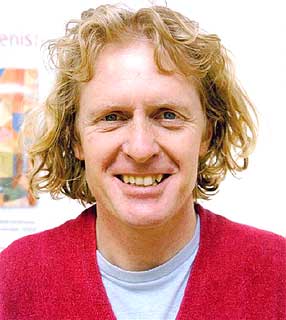
Grayson Perry Introduction and Video

 
Grayson Perry (born 24 March 1960) is an English artist, known mainly for his ceramic vases and cross-dressing. Perry's vases have classical forms and are decorated in bright colours, depicting subjects at odds with their attractive appearance. There is a strong autobiographical element in his work, in which images of Perry as "Claire", his female alter-ego, often appear. He was awarded the Turner Prize in 2003. (Wikipedia)